Showing posts with label SPAD. Show all posts
Wednesday, February 24, 2016
1997 - Painting the Fuselage and Tail
The rudder looks blue in this picture but it's silver (aluminum) dope. The bad thing about old film photos was that you didn't know it came out badly until it was too late to retake the picture. Digital pictures do have some advantages. The colors Red, White, Blue, and Black do not have aluminum pigment in them so they need an aluminum base. I wanted to see how the finish would look in WWI so I only put on the coats as they did back then. If I were doing this again I would shoot silver dope before doing any of the colors. It was hard to avoid gaps between colors, and thin areas from brushing inconsistencies.
The colors were brushed on starting with the lightest color to the darkest color. That way the dark colors can overlap the lighter colors. The tail surfaces are setting on saw horses behind the fuselage. The tail colors are still part of the Kellner pattern. Each color was applied to all parts then the next color in that order.
The fonts used on the tail were based on photos of SPAD planes. In Aviation and Aeronautical Engineering magazine, November 1, 1919 pg. 298, there was an article by Randolph Hall which explained the loads P.C. and P.U.
The loads P.U. and P.C. are given in kilograms.
P.C. is Poid Combustible, Weight of Combustible fuel. 50kg = 110lb = 18.3 Gallons (I've since made the tank smaller, about 14 Gallons)
P.U. is Poid Utile, Weight Useful, Pilot, Ammunition, Equipment 125kg = 275lb.
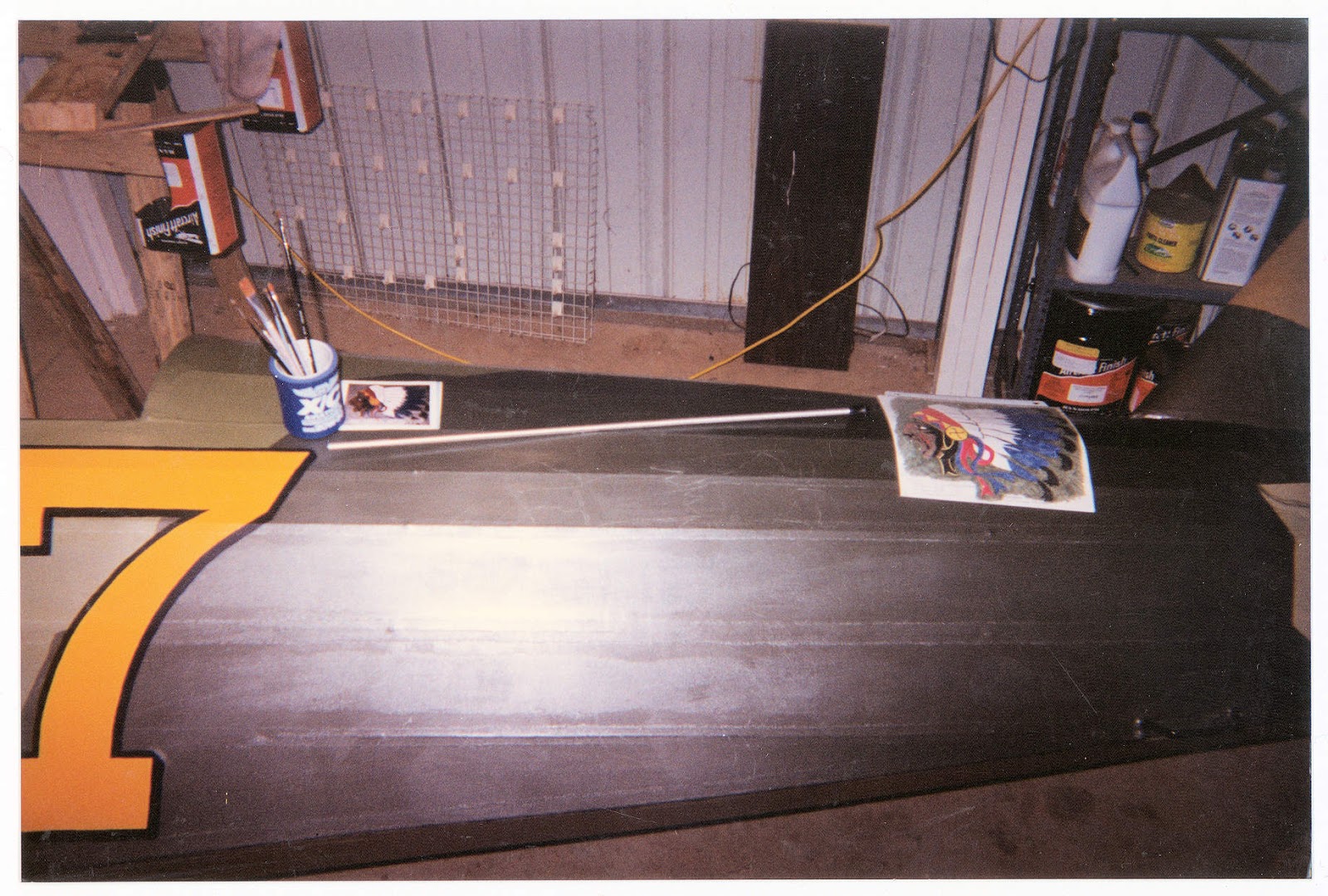
The markings and insignia were painted on using the normal tools of sign painting except the colored paints are dope instead of normal sign paints.
A pounce pattern was used to chalk a faint outline on the fuselage. It's like paint by numbers, you just paint inside the faint chalk lines of dots. The chalk holes are poked in the pounce pattern with a star wheel. A pounce bag (filled with chalk dust) is used to dust chalk through the holes.
The pattern helps make both sides the same.
They really came out well for a first attempt at sign painting.
Labels:
Fuselage,
Paint,
SPAD,
Tail Surfaces
Sunday, February 21, 2016
A new SPAD Paint Job
While planning to recover the plane I decided to use a more accurate WWI paint job on the plane but could find no information. Even the Air and Space Museum had no information, I still don't believe them. In the early '90's we saw an ad in the local paper for an auction at a house near the old stone quarry with some airplane items. It was a small house in a working class neighborhood. It only took about an hour or so to sell the house and contents, and then we moved to the small one car garage for the airplane items. The owner had wanted all of this donated to the Virginia Aviation Museum, but never wrote a will. His heirs wanted the money. Everything he had was in it's original box or envelope so each item had to be removed from it's packaging and only then could it be auctioned off. We spent all day Saturday, all day Sunday, All day the next Saturday and all day the next Sunday when the auctioneer finally quit and would go no further. I got some great bargains and marvelous treasures.
One treasure was a complete set of Cross and Cockade Journals in their original envelopes. It was published quarterly by the Society of World War I Aero Historians form 1960 to 1985. The magazines were filled with pictures and research people had done on WWI aviation. One piece of research was "Project Butterfly" by Allan Toelle, et al. They had researched French camouflage colors including the pigments and formulas to make the colors. They also had figured out the paint scheme used by each subcontractor which built SPADs. SPAD or the Société Pour L'Aviation et ses Dérivés, which roughly translates to Society For The Aviation and its Derivatives, built 2 of the great fighter planes of WWI. Along with the Fokker DVII and the SE-5a, the SPAD VII and SPAD X111 were state of the art in the later part of the war.
The goal was to make the Fly Baby to look like it had been sent to one of the SPAD subcontractors to be painted. I selected Avionnerie Kellner Frères (Airplane Builder Kellner Brothers) as the painters for my plane. Kellner was a famous coach builder for luxury car makers of the period. They had become plane builders to help SPAD with the war time problem of more orders than they could build. Keep in mind that able bodied young men went off to be slaughtered in the trenches and the old and women new to the work force did all this work. The first airplane they probably ever saw was on their first day of work. They were not building museum pieces nor the high quality coaches for which Kellner is still famous.
From the information in Cross and Cockade I created Fly Baby paint job based on the patterns which Kellner used on their SPADs. They had a distinctive angular scheme. It was so consistent in layout that I assume they had patterns they used to draw out the scheme on each plane. They also hand brushed the paint, not sprayed. Because the colors used on the fabric include aluminum powder, to protect the fabric from the sun, the colors are what we would today call Metallic. As a result of the aluminum powder leaves brush streaks so you can see every brush stroke in the old pictures.
I chose the markings of the 103rd Aero Squadron of the 3rd Pursuit Group, 1st Pursuit Wing, 1st Army, American Expeditionary Forces. They were the successor to the Lafayette Escadrille which meant they got to have the coolest Indian Head insignia of the 4 squadrons in the group. Based on the order issued 27 August 1918 they had the Green (3) and Red (2) stripes on the upper and lower wings, as well Yellow and Black airplane identifier numerals on the fuselage. I've chosen the Red nose of the 1st Flight aircraft. The Indian Head used during this period was vary consistent which would imply they had a pounce pattern they used to layout the insignia on the fuselage for the sign painter to follow.
Unfortunately when I tried mixing colors based on the formulas in the "Butterfly Project" they all came out wrong. I can only assume they did not measure their pigments with enough precision, I'll never know. As a result I took their information and built an Excel spread sheet to calculate the formula for each color. I them made samples and took them around to various museums during my business travels until I had formulas which consistently matched old fabric. I also bought color standards (8" x 10" sheets) from Munsell to match or bracket the colors they found when they measured old fabric. My samples included pieces of the Munsell sheets and actual dope samples from my last mix.
The pigments were mixed with a mortar and pestle. The colors don't look correct at all until you add the aluminum powder to the dope mix.
I now have an Excel spread sheet which allows me to calculate any quantity of dope. I also have extra pieces of the Munsell sheets and a 30 gallon drum of aluminum powder. Today dope makers sell the aluminum as paste so there was no easy way to figure out how much to use to get the correct colors.
If you need help with French Camo. I can help, send me a note.
At first some of the colors were way off from the old fabric. By taking pictures and making notes I quickly got to where the colors matched. Then it was a process of finding more places to visit to check the colors against more samples.
I don't know if the American units repainted the National markings so I assumed they were painted on at the French factories using their colors. The wing at the right is on a Caudron at the Air and Space Museum, everything is factory original. The sample below seems to agree with my factory paint theory since the cockade it was cut from is clearly the American order of the colors using French dope colors.
Here is a sampler of the colors doped on Grade A cotton fabric. With all this information it's time to start painting.
One treasure was a complete set of Cross and Cockade Journals in their original envelopes. It was published quarterly by the Society of World War I Aero Historians form 1960 to 1985. The magazines were filled with pictures and research people had done on WWI aviation. One piece of research was "Project Butterfly" by Allan Toelle, et al. They had researched French camouflage colors including the pigments and formulas to make the colors. They also had figured out the paint scheme used by each subcontractor which built SPADs. SPAD or the Société Pour L'Aviation et ses Dérivés, which roughly translates to Society For The Aviation and its Derivatives, built 2 of the great fighter planes of WWI. Along with the Fokker DVII and the SE-5a, the SPAD VII and SPAD X111 were state of the art in the later part of the war.
The goal was to make the Fly Baby to look like it had been sent to one of the SPAD subcontractors to be painted. I selected Avionnerie Kellner Frères (Airplane Builder Kellner Brothers) as the painters for my plane. Kellner was a famous coach builder for luxury car makers of the period. They had become plane builders to help SPAD with the war time problem of more orders than they could build. Keep in mind that able bodied young men went off to be slaughtered in the trenches and the old and women new to the work force did all this work. The first airplane they probably ever saw was on their first day of work. They were not building museum pieces nor the high quality coaches for which Kellner is still famous.
I chose the markings of the 103rd Aero Squadron of the 3rd Pursuit Group, 1st Pursuit Wing, 1st Army, American Expeditionary Forces. They were the successor to the Lafayette Escadrille which meant they got to have the coolest Indian Head insignia of the 4 squadrons in the group. Based on the order issued 27 August 1918 they had the Green (3) and Red (2) stripes on the upper and lower wings, as well Yellow and Black airplane identifier numerals on the fuselage. I've chosen the Red nose of the 1st Flight aircraft. The Indian Head used during this period was vary consistent which would imply they had a pounce pattern they used to layout the insignia on the fuselage for the sign painter to follow.
Unfortunately when I tried mixing colors based on the formulas in the "Butterfly Project" they all came out wrong. I can only assume they did not measure their pigments with enough precision, I'll never know. As a result I took their information and built an Excel spread sheet to calculate the formula for each color. I them made samples and took them around to various museums during my business travels until I had formulas which consistently matched old fabric. I also bought color standards (8" x 10" sheets) from Munsell to match or bracket the colors they found when they measured old fabric. My samples included pieces of the Munsell sheets and actual dope samples from my last mix.
The pigments were mixed with a mortar and pestle. The colors don't look correct at all until you add the aluminum powder to the dope mix.
I now have an Excel spread sheet which allows me to calculate any quantity of dope. I also have extra pieces of the Munsell sheets and a 30 gallon drum of aluminum powder. Today dope makers sell the aluminum as paste so there was no easy way to figure out how much to use to get the correct colors.
If you need help with French Camo. I can help, send me a note.
At first some of the colors were way off from the old fabric. By taking pictures and making notes I quickly got to where the colors matched. Then it was a process of finding more places to visit to check the colors against more samples.
I don't know if the American units repainted the National markings so I assumed they were painted on at the French factories using their colors. The wing at the right is on a Caudron at the Air and Space Museum, everything is factory original. The sample below seems to agree with my factory paint theory since the cockade it was cut from is clearly the American order of the colors using French dope colors.
Here is a sampler of the colors doped on Grade A cotton fabric. With all this information it's time to start painting.
Labels:
General Info,
Paint,
SPAD
Subscribe to:
Posts (Atom)