Sunday, November 15, 2015

1972 - 1973 - Changes and Repairs for Fly Baby

In early 1972 Ernie decided to make some changes on the Fly Baby and repair some accumulated hangar rash.  The plane was originally covered with Razorback fiberglass cloth.  Probably I good fabric for some applications but a little heavier than Cotton or Ceconite.  The fabric was donated if we would demonstrate it a Chapter meeting, which we did.  It only cost us for the dope.  Today I would only recommend Poly Fiber (Stits) or if you want to use dope then Ceconite.
One of the problems to be fixed was that we used aluminum flashing for all the leading edges.  It's just too soft.  It was beaten up pretty badly and probably most of that happened the first year.

The tail surfaces got beaten folding the wings and moving the plane.  One change during this process was to ad handles to the fuselage for ground handling.


Even the fin was pretty beaten up.
One of the things we realized was that at this point the plane was not likely to be trailered except to bring it home for the winter.  As a result there was no need for the flat fuselage sides.  With a fully cowled engine it would be nice to have the fuselage rounded to match the cowl.
We also found some water damage under the fabric.  This was before epoxy varnish so all the wood touching fabric was just sealed with dope, not adequate
We realized we already had a heavy airplane so we asked Pete if there would be a problem if we cut away the plywood on the fuselage sides to offset the weight of the stringers.  He said the only reason he used plywood on the sides was to make it simpler to build than if all the joints were just gusseted.  We managed to save all the weight of the formers and stringers and it wasn't all that hard to do.  It took a little layout work and some time with a saber saw. If I were building a new plane I would do it and put 2 stingers to just lift the fabric from the sides of the fuselage, about like a CUB.

With the fuselage lightened the next task was to make plywood template of the firewall and add formers for the stringers at each fuselage bay.


Some wood block were needed at the wing root so the wing would be tight to the fuselage even though the fabric was almost an inch out at the top of the wing.
With the strings added it was time to varnish everything.  It really give the fuselage a nice look.


The original A-65 engine resting while the the plane gets worked on.  Good memories of going with Dad and Gene Tanner to Andy Anderson's place near Rantoul, Illinois to pick up this engine and a CUB fuselage for Gene.  I rode home to Michigan sitting in the fuselage, on it's side, with the tailgate of our '58 Chevy Wagon open and the fuselage sticking out a long way.  The engine was strapped on the roof.  Life doesn't get much better.
The left wing hanging in the rafters of Debbie's horse barn.

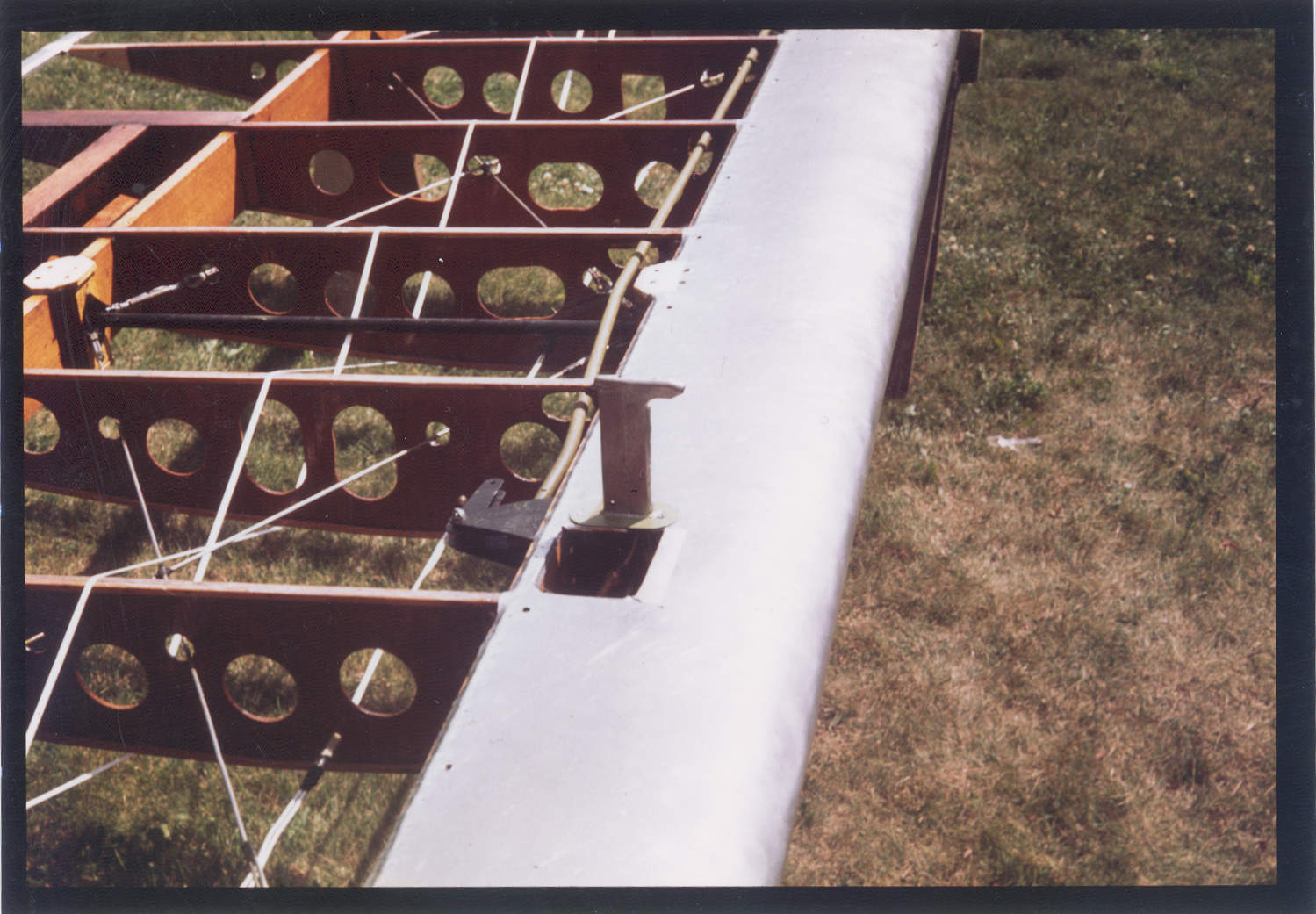
The Aluminum on the wings was as all pulled off and replaced as well.  Some areas were not bad and others were really beaten up.

Everything ready to add the aluminum back on.  There were minor repairs to the ends of some ribs but otherwise the wings were solid.


We changed the pitot tube to one that hopefully would not be so easy to damage.  You can't have it here if you fold the wings against the fuselage.

The wings are ready for cover.


The instrument panel was rearranged to add room for a radio.

The panel is also slightly taller.  This also move the wind screen up a bit higher.

The cockpit was trimmed with naugahyde with some carpet on the floor.  I like the look of bare wood better but it made it very finished looking.


Pre-cover assembly to make sure everything fits properly.


Back to the shade for the dope and fabric work.


Assembling a new cowl to fit the sexy new lines.


Ready for color
Somehow I talked Dad into painting the plane to look like Jimme Matter's Lockheed Vega.  I just thought it was cool and fit the Fly Baby by just moving the wing down.  It was a lot of work to layout and paint but I liked it.

Brother David doing the hard work.


The plane is finally back to the airport for a test flight around the 4th of July 1973.  A year of fixing and changes finally over.  I believe that is Geof Geisz doing the flying.

That summer Ernie made it back to Oshkosh.  The next year the Christen Eagle arrived with a stylized version of the eagle.  I can only hope we inspired him.

After 4 years in the Air Force Dennis was able to make 2 flights in Fly Baby while it was at Oshkosh this year and one more in September.  His next flight in it wouldn't be until April of 1990 when he moved it to Waynesboro, Virginia.

The last trip for this year was to Rixport.  It's now a  Dump (land fill).

Wednesday, November 11, 2015

1971 - Flying to Local Events

While Dennis was at Yokota Air Base in Japan and Grissom Air Force Base in Indiana, Ernie had fun flying to local events at Bay City, Lapeer, Owosso and Hastings.  It must have been a mild fall since his last flight that year was on November 11th.  The year ended with 100 hours total time on the Fly Baby.

Monday, November 9, 2015

1970 - A new Paint Job and Oshkosh


 After setting at the farm for the winter Fly Baby got a new military paint job.  The paint work was done and new tires installed by early June.

 All the work was done outside.  The new horse barn had not yet been built.


 With the work done it was back to flying on June 13th, I hope it wasn't a Friday.  Several local flight were made as well as a trip to Owosso and one to Bad Axe.

With about 7 hours of current time in the plane Ernie headed over to Flint's Bishop Airport for the start of the AC Spark Plug Flight Rally to that new place called Oshkosh.  Fuel stops were made at Elkhart, Indiana, Joliet, Illinois, Morris, Illinois, Waukesha, Wisconsin and on to Oshkosh.  He managed one flight in the fly by pattern and then at the end of the week back Home to Dalton Airport.


 The flying season ended in late October but there had been plenty of opportunities to hang out with friends like Shel Williams, here with his Fly Baby.

The picture below is at Dalton Airport looking southeast the planes behind the Fly Baby are:
Keleher Lark - Bob Voto,
Smith Miniplane - Howard Nixon,
Fly Baby - Shel Williams,
Pitts Special - Dwayne Trovillion,
all Chapter 77 members.
Nice day at the airport.


1969 - Restriction Removed & Back to Rockford

1969 was a very good year.  In the fall of 1968 Dennis enlisted in the Air Force and then in February came home to marry Patricia (still married).  On July 24th Robert Bush of the FAA signed off the Fly Baby for Unrestricted Operation.  Ernie flew to several fly-in events around Michigan, Gladwin, Lapeer, Lippert, Caro, Chesaning, and Newton.
 Before Rockford Francis Londo flew his Fly Baby N2288C from Bothell, Washington and stopped at Dalton Airport to visit Ernie and fly our Fly Baby.

A beautiful summer day over Flint.


 With the restrictions removed Ernie was able to fly to Rockford in the AC Spark Plug Flight Rally.  I believe this picture was taken at the Morris, Illinois fuel stop.
 Tied down back at Rockford for the afternoon airshow.  Patricia and I joined Dad to camp at Rockford.  I was reassigned after teaching one class as an instructor at Chanute.  We were on leave before heading to Japan for 2 years.  We joined Chapter 361 at Tachikawa Air Base where I was able get my A and P license.  I rebuilt a Stinson L-5A for my practical exam.  Good Fun.  John Condon and Al Pitts, 2 perfectionists, taught me about matched hole aluminum construction as they built their Thorp T-18s.  Al was my examiner for my A and P, Thanks Al.
Ernie heading out for some Fly-Bys at Rockford.  Ah the good old days when you could fly at the Fly-In.


 We managed to again park next to Pete who brought his Fly baby back as a Bi Baby.

After flying it Ernie couldn't wait until he could retire and build the Biplane wings.


Back to the farm for the winter.

Sunday, November 8, 2015

1968 - Adding Hours To Remove the Flight Restrictions


During 1968 another 22 hours were flown on the Fly Baby.  Dennis passed his Private Pilot check ride in August and finally got to fly the Fly Baby putting 7 hours on it before cold weather set in.  The rest of the time on the plane that year was flown by Ernie, Ray Shelby and Shel Williams

1967 - Ups & Downs

At the start of 1967 the Fly Baby had accumulated 6 hours 15 minutes.  Neither Ernie nor Dennis had flown the plane yet.  Ernie got his first flight on May 6.

In April we finished the repairs to a Taylorcraft L2-M, N47469, which Ernie bought for $125.  We each got to fly it April 5th.  It wasn't much of a performer but it flew and gave us some tail wheel practice before flying the Fly Baby. Dennis put 12 hours on the T-craft that year despite spending the summer working in the Upper Peninsula of Michigan.

 A hard landing in the Fly Baby pointed out a problem we had caused by using 700x6 wheels instead of the 800x4 wheels like Pete used.  There is no shock absorption in the smaller, higher pressure 700x6 tires.  As a result the axle bent.

Fortunately the wood gear legs are very strong and did not break.


 Another factor which made it easier for the axle to bend was the position of the steel bar in the center of the axle.  It provides an attachment for the wing flying wires.  The drawing for it is not clear enough as to orientation.  The bar should be nearly vertical so the load on each end of the shackle would be equal.  The center line of the pin through the shackle should be about parallel to the bottom of the wing, which make the bare nearly vertical.  With the bar vertical it helps stiffen the axle.

The lower image in Figure 2-5 make it look like the bar is parallel to the wing and the pin vertical.  A side view of the bar and axle would have made this clearer.

A new gear was quickly built but it was much later that we found the bar was installed wrong.  We were lucky the shackle didn't fail.  We were able to leave the bar and make some plates to replace the shackle.  The bar is still in the wrong position.  If I get around to putting the Monoplane wings back on I'll replace the axle to turn the bar vertical.
 The plane is back at Dalton airport near Flushing, Michigan for the annual Dawn Patrol with 800x4 wheels and tires.


We know who 2 of the 3 people looking at the plane are.  The person facing the camera, wearing a ball cap, is Howard Nixon of Cheasining.  Howard built a Smith Miniplane, N66N.  The person with his back to the camera is Ray Shelby.  Ray built a Baby Ace in a small cottage a few miles from Dalton.


 Fly baby heading out for another flight.

On August 10th Ernie passed his Private Pilot check ride, Freedom At Last!  Congratulations Dad!

In addition to Dwayne and Ray, 1967 saw several more Chapter 77 members get to fly the plane, Howard Nixon, Gordon Hale, Harley Fortier, Jim Burris, and Shel Williams all took a turn.
 Back on the flight line at Dalton Airport.
I wonder if the the colors of the champ inspired my Dad to pick those colors for the Fly Baby, White with Light Blue trim and Red stripes.  He doesn't think so but I'm sure the champ was at the airport before we painted the Fly Baby.  I'd never thought about it until I recently saw this picture.

The year ended with 18 hours, 30 minutes flown toward the 40 hour restrictions and I had not yet flown the plane.