Friday, November 24, 2017

Aileron Gap Fillers and Hinge Problems

I've always thought the ailerons on the Biplane Fly Baby were slightly inadequate.  I've run out of aileron trying to hold the wing down on crosswind landings and had to go around.  The wings on the Bi-Baby are shorter so the ailerons are a little less effective.  We've never had gap fillers between the 5 sections of piano hinge, which I'm sure contributes a little more to the problem, by letting air flow through from the bottom of the wing.

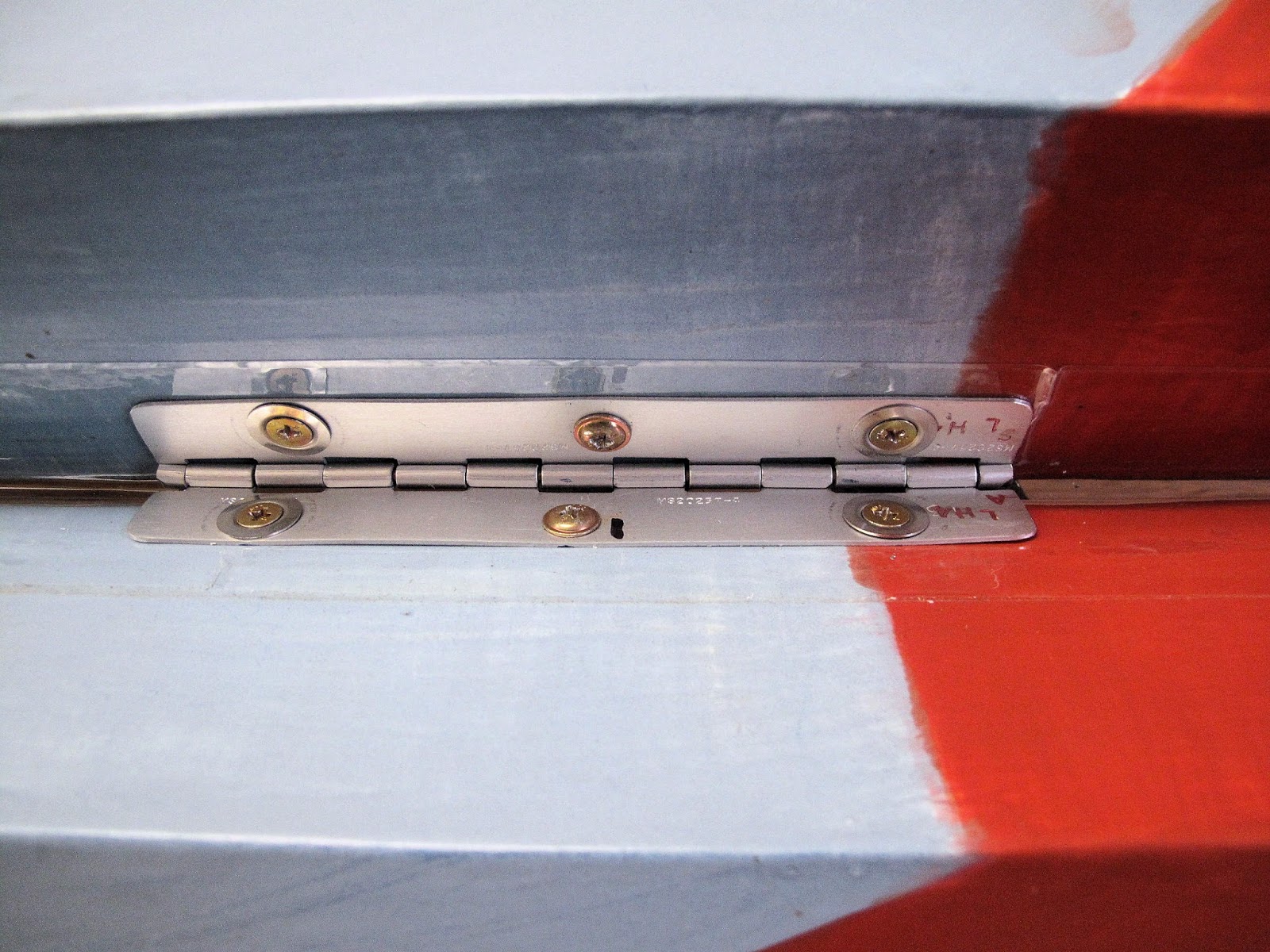
I've thought about ways to add gap fillers which are simple and easily replaced if needed.  The idea I settled on is to use strips of clear vinyl, taped to the wing and the aileron, and held secure by the hinges.
 My first plan was to cut strips of vinyl 2 3/8" wide with 1" double sided tape along each edge.  When I went to install them I realized I needed a bigger, 5/8", gap at the moving part of the hinge because of where the tape actual touches the fabric.
 I cut out the screw holes in the fabric before installing the tape, to make it easier cutting the holes in the tape.

The tape was applied to the aileron first.  It seemed to make installing the aileron easier.  I realized I needed to hold the wing side of the vinyl strip to the hinges to keep from wrinkling it.  I used a strip of 1/2" wide double sided tape to hold it to the hinges.  The vinyl was taped to the hinges with the hinges folded closed.


 The screw holes were cut through the vinyl and tape before installing to the wing so the screws could be easily positioned.

I played with the idea of slowly removing the paper backing as I installed the aileron.  That didn't work.  The better idea was to remove it all and install the aileron starting at one end.


 I used washer head screws to give a good bearing area with a thin screw head.  I put the screws in the first hinge and pushed them into the wing holes while keeping the other end of the aileron a couple inches out so the tape wouldn't get stuck in the wrong place.

I worked one hinge at a time installing the screws until they just engaged the nut plates, then on to the next hinge.  As each hinge was added I tightened the screws on the earlier hinges, a little, to slowly pull the tape and aileron to the wing.

 It worked out well with a nice even gap filler.  Once the tape was in place I used a squeegee to make sure the tape was tightly adhered.

A fairly simple gap filler.  We'll see how it works in flight.


 While installing the gap filler on the left wing I realized there was a problem with some of the screw heads hitting each other.  This prevents the aileron from having full down deflection and puts a strain on the hinges.  Some of the screws should have had more offset so the heads would miss each other.  The Right wing screws were all well spaced,  Some learning must have happened with the left wing.  To get more travel I replaced the offending screws with flat head screws and stainless steel countersunk washers.  I had to take the hinges back off and countersink the screw holes.  The washers assure the crews will not pull through the hinge and add a little better clamping force.

 I also found that the right hand aileron was positioned 1/8" high relative to the wing.  I have no idea how I missed this when I made the new hinges.  The only practical solution was to make new hinges moving the holes on the aileron side down 1/8".  The hinges were well positioned on the wing side so there wasn't any benefit to moving them.  The original hinge holes were easily made with the fabric off the wings.  This fix had to be done without getting into the wing or aileron.

I decided to only make new Aileron halves so I wouldn't accidentally mess up the holes on the wing side.  The wing side pieces were crimped on the ends to trap the hinge wire.

 To get the wire out I rounded the end of a 3/32" pin punch and used it to remove the crimp on the ends.  Then the pin could be driven out.


 With the pieces separated the trick was how to move the holes down 1/8" on the aileron piece without accidentally moving any of them in another direction.
 I used the belt sander ground the loops of the old hinge piece thin enough to break them off.  I didn't want to accidentally grind off too much since the plan was to use the remaining ends of the loops as stops to position the piece as a pattern for punching the new holes.

 Using needle nose pliers I rolled the old loops to break them off.


 I then used the belt sander to carefully grind the loop ends to a perfect length.   It took a few passes at the sander to get them just right.
 I clamped the old piece on the the new one and then measure the offset, and reground the ends until I got the offset to 1/8" +- .002".


 With the old part clamped on as a pattern, the screw holes were punched in the new piece.  Each hinge was reassembled and reinstalled.  The aileron now fits perfectly.

Thursday, November 23, 2017

Post Painting - Wing Assembly

I've been up to my ears with work for the past few months.  I have gotten a few little things done and Thanksgiving Weekend seems a good time to get caught up and back to work on the Fly Baby.

 I decided to use wing walk tape rather than the gritty paint.  I wasn't sure how the paint would work with Poly-Tone.  I cut pieces 24" long and a little narrower than the wing walk.  I also rounded the corners so they wouldn't tend to come loose.  I heated the tape to about 150 degrees so it would stick well and conform to any bumps.  To help stick it down I made a roller from a piece of foam noodle the grandkids had in the summer.  I used a piece of tubing in the center, which was setting on my work bench, but a piece of dowel would work well to give it some stiffness while pressing the tape down.

 I've bolted all the strut and brace wire fittings back on the wing panels.  I have a plan to paint all the inspection covers with Poly-Tone to match the wings better but it's a fussy process of priming with epoxy primer than spraying the first coat of Poly-Tone while the last coat of primer is tacky.  I'll work on them when warm weather returns.  For now I've found some spray cans with colors close enough.  I only have a few covers needed until the first annual inspection.

As I put the fittings back on I mounted the wing strut to each wing to make sure all the fittings were on correctly and the bolts would fit.  Much easier to resolve any problems in the attic then while assembling the whole plane.

Sunday, August 13, 2017

Better Paint Mix and Second Coat on the RH Upper Wing

When I mixed a new batch of light green, I realized I had made some mistake with my spreadsheet for calculating the pigments.  It was causing the quantities of pigments to be so low the paint was watery.  I had seen this with the red, blue and black, but it was much worse with the green.  I spent the morning re-measuring all my pigments by weight and volume to determine their density.  I needed this to correctly convert my weight (gm) measurements into volume (ml) measurements so I could use measuring scoops.

When I first mixed the colors I had access to a very accurate scale.  All I have now is a small kitchen scale which is not accurate enough to measure such small quantities.  Most of the pigments come in 175 ml jars so I have large enough quantities to work out the density with the kitchen scale.
The densities are:
Lamp Black                     0.17 gm/ml
Aluminum Powder           0.27
Prussian Blue                  0.55
Alizarine Crimson            0.66
Litopone                         0.83
Burnt Sienna                   0.87
Chrome Yellow                0.87
Chrome Orange               1.18

 When I mixed the colors I used about 4 times as much pigment as my attempt with the Light Green, which was what I found with the black.  The colors still match and the paint covers much better.
The color mixes here are for Light Green, Beige, Red and blue.  Each has about 25 ml of pigment for a quart of Poly-Tone.  The Alizarine did not want to mix well with the Poly-Tone but the color seems to match my old samples.
 We had another warm dry afternoon so I started the numbers on the lower left wing, and did the red and blue on the roundels.

The upper right wing got a second coat on all the colors.  The red and yellow need another coat and then I can outline the numbers.

After 26 years it's nice to see this paint job getting close to being done.  I really like the look.


Thursday, August 10, 2017

Colors on Wings


 The afternoons yesterday and today were both nice and dry for painting.  Yesterday I got the second coat of all the colors on the top of the lower wings.

I also got started on the red in the roundels.  The green stripes are squadron stripes for the 103rd Areo Squadron.  They still need red stripes between the green.


 In the evening when it was too damp to paint to paint I drew all the color boundaries on the top of the upper wings.

Today I was able to get the first coat on the top of both wings.  When the colors are done I'll add a black border around the numbers.


 The upper right wing gets the same green and red stripes as the lower left.

I got the numbers drawn on the lower right in the evening today, but it was too damp to paint them.  Odds are I won't get to do any more painting until mid September.

I did get the gasket set for the engine so I can pull the cylinders to check for rust.  I've only got about 125 hours since the overhaul so I don't want to risk damaging the engine.

Sunday, August 6, 2017

Painting the Camouflage Colors on the Wings


 The weather has dried out for a couple days so I finally got some color on the top of the wings.  I bought 4 gallons of the clear Poly-Tone base so I can mix my own colors.  I also bought a quart of Blush Retarder to slow the drying and help with mixing the pigments.  Austin at Preferred Air Parts was very helpful.
I found a plastic lid, at the hardware store, for the gallon can which has a small poor spout.  It allows me to easily poor small amounts of the base without making a mess.
 Based on my color formulas I measure the pigments into my mortar.  This mix is for making 1 quart of the dark brown, Chestnut, color.  It uses Lamp Black, Chrome Orange, Chrome Yellow, Burnt Sienna, and Alizarine Red.
 When I did this with dope I used one of the plasticizers for mixing the pigment.  With Poly-Tone I used some blush retarder, 4 teaspoons for a quart of Poly-Tone.  It gave me a liquid which wouldn't dry quickly while grinding the pigments and it helps the Poly-Tone flow out the brush marks before it drys.

You grind the pigments with the pestle until you get a good even color mix.  You can see the color change as you grind it together.

 The hardware store sells empty paint cans.  My little paint spatula bends nicely to scrape most of the mix from the mortar.  When I did this with dope I used a little thinner to wash the last of the pigments from the mortar.  The Poly-Tone is already very runny so I didn't want to add thinner.  Instead I cleaned it a couple times with a couple tablespoons of the clear Poly-Tone.  It worked pretty good but I didn't get it as clean as with thinner so I used 1/4 more pigments to allow for some not getting to the can.


 Once the pigment mix was in the can I added the aluminum powder.  For this color it takes 14.75 ml, 3 teaspoons of aluminum.

Then I fill the can 1/2 with Poly-Tone and shake it vigorously for 3 minutes.  I don't know if less will work as well but 3 minutes is all my arms can take.  I then finish filling the can and shake it another minute.  The Poly-Tone is so runny you need to stir it often while painting.

 I start with the lightest color and work to the darkest so each color can overlap about 1/4".  The beige seems a little lighter than the dope on the fuselage but the other colors match very well.  2 coats seem to get a good even color.

 The process is pretty simple.  I draw the pattern on the surface with a soft lead pencil, which won't bleed through the Poly-Tone.  The patterns used by each of the SPAD subcontractors were so consistent that they must have had a pattern they traced for each surface.  Mine were free handed from my sketch.

I mixed a quart of each color, except Black for which I only made a pint.  It looks like I'll need another quart or 2 of beige and light green.  Originally I planned to mix a gallon of each of these colors but I'll never use that much.

I finished the center section and ailerons.  I've got one coat on the top of the lower wings, none on the upper wings.


 I also got the first coat on the blue for the lower wing roundels.  The blue and the black both seem much weaker with Poly-Tone than they did with dope.  I probably could have doubled the amount of pigments in the blue, and I used 4 times a much lamp black to get it to cover in 2 coats.  Mind you, I used 4 teaspoons of lamp black in a pint of Poly-Tone, and I have 5 quarts of lamp black dust.  I won't use it up in a thousand years.

I did find the Poly-Tone a pain to brush compared to dope.  It runs easily and you get bubbles easily while brushing.  I'm getting the hang of it and it looks great.  I really like the look.  Because of the aluminum powder you see every brush stroke so it has much more life to it.  It also looks Like WWI French Camouflage would have looked.