Friday, November 6, 2020

Changes To Motor Cowling Outlet - To Improve Cylinder Head Temperature

 Fixing seal leaks didn't solve the Cylinder Head Temperature (CHT) problem.  I have nice big inlets with the Taylorcraft nose bowl, so my next area to work on is the outlet opening.  When I made the new sheet metal I tried to duplicate all this as carefully as possible so it surprises me to be having cooling problems.

The outlet has a skirt, like a cowl flap, which is about 4" tall and hasn't changed since shortly after we built the plane.
I started by checking the angle it's tipped back.  From old photos it was tipped back at 125 degrees.  I have this nice antique folding ruler.  The center joint is stiff enough that it works nice for measuring angles.  Using my best protractor the new skirt measures 130 degrees.  I'm not sure that's enough difference to matter, but my friend Fred suggested a way to adjust this angle.


The idea was to cut off the flange on the ends of the skirt and replace them with brackets to allow the skirt to be bolted at different angles.


I worked out a pattern of 4 bolt holes which allow the shirt to be tipped in 3 different positions with 2 3/16" bolts holding it together in each position.  In the center position the 2 outer holes are used.  In the other 2 positions an outer bolt and it's inner neighbor are used.  This allows the skirt to be at 125, 130 or 135 degrees.  We'll see if it matters.

Once I had this done I realized I'm more likely to get better cooling with a larger outlet opening than the angle of the skirt.

Some quick measurements showed I could move the ends of the skirts outboard 1" and still clear the exhaust pipes.  That would add about 8 square inches to the outlet opening.

I decided to also move it forward 1".  I took the cut out piece, scanned it, and brought it up in TurboCAD.  This allowed me to draw the outlines of the old and new openings to measure their areas.  The old opening was 61.4 Sq. In.  The new one is 86.9 Sq. In., that's an increase of 25.5 Sq. In. or 41.5%.  That seems like a good change.
Rather than make a whole new skirt I cut it in half and put the cowl back on the plane.  Then I fitted up a piece to fill the gap, with a backing plate to tie it all together.  It worked fine.
The next thing was to prevent air going in the openings around the exhaust pipes.  I increased the openings about 1/4" all the way around to give the pipe some more clearance.  It looked like the pipe had rubbed on the cowl at some point in the past.  Because of the angle on the bottom of the cowl, that extra gap may be letting air in, reducing the pressure drop across the cylinders.

My research on line shows that the air pressure on top (inlet side) of the cylinders should be about 5-8 inches of water higher than on the bottom (outlet side).  I think I've figured out how to mount a U-tube manometer to measure this if needed.
For now my plan was just to make some skirts around the pipe openings to prevent air entering.

The skirts have tabs for riveting them to the cowling.  I cleco'd the long side flange in place and used stacks of popsicle sticks to wedge the skirts in place to mark the other tab holes.

Back to the attic to rivet it all together.


It was a bit of a pain to hold and rivet by my self.  I eventually pulled a bungee cord across it which made it easy to hold.

Everything is done and back on the plane.  I'll pretty it up once it all works.

I've made 2 flights with all this.  On the first flight I had the skirt in the center, 130 degree, position.  The problem is not solved but it was a big change.  In level flight the CHT dropped from 460 degrees F to 415-420.  I'd like it in the range of 360-390 degrees F, but this is going in the right direction.  The oil temp after 25 minutes had slowly climbed to 185 degrees F.  It was 210 degrees after 15 minutes before so the motor is running cooler.

For the second flight I moved the skirt to the shallower 135 degree position, No change.  

I did have two nice flights just before sunset and the plane flies great.  I can feel a difference in how the plane turns when well coordinated and when 1 ball width off, so I should be able to learn to feel when I'm making good turns.  

Last night I also tried the cabin heat.  It works great and creates a nice bubble of warm air in the whole cockpit, very good.  I should be able to fly most of the winter here in Virginia.

I'll try the 125 degree position next flight.  After that I'll work on the manometer and consider moving the skirt forward another inch.  I also need to look at possible air leaks by the carburetor.

I'm having fun with all this.


Wednesday, October 21, 2020

A longer Test Flight

 Today was another nice warm day with a light breeze out of the southwest.  I flew about 20 minutes.  The motor was still running hot, 450 Deg. F.  I flew around the pattern until the oil temp. got close to red line, then landed.  When I went to pull carb heat I found I had been flying with it on heat.  I think what happened was I was going to land on the first pass around because of the temp. and pulled carb heat on downwind, then changed my mind and kept going around, forgetting to move back to cold air.  I'll probably give it another go tomorrow.


My landing was better.


I took this video on on pass around the pattern  It starts toward the end of the downwind for 23.  It ends after turning to base, toward the mountain.  Just at the end you can see Gordonsville airport between the left wings.  The mountains way in the back are the Blue Ridge.  It was a nice afternoon.


Sunday, October 18, 2020

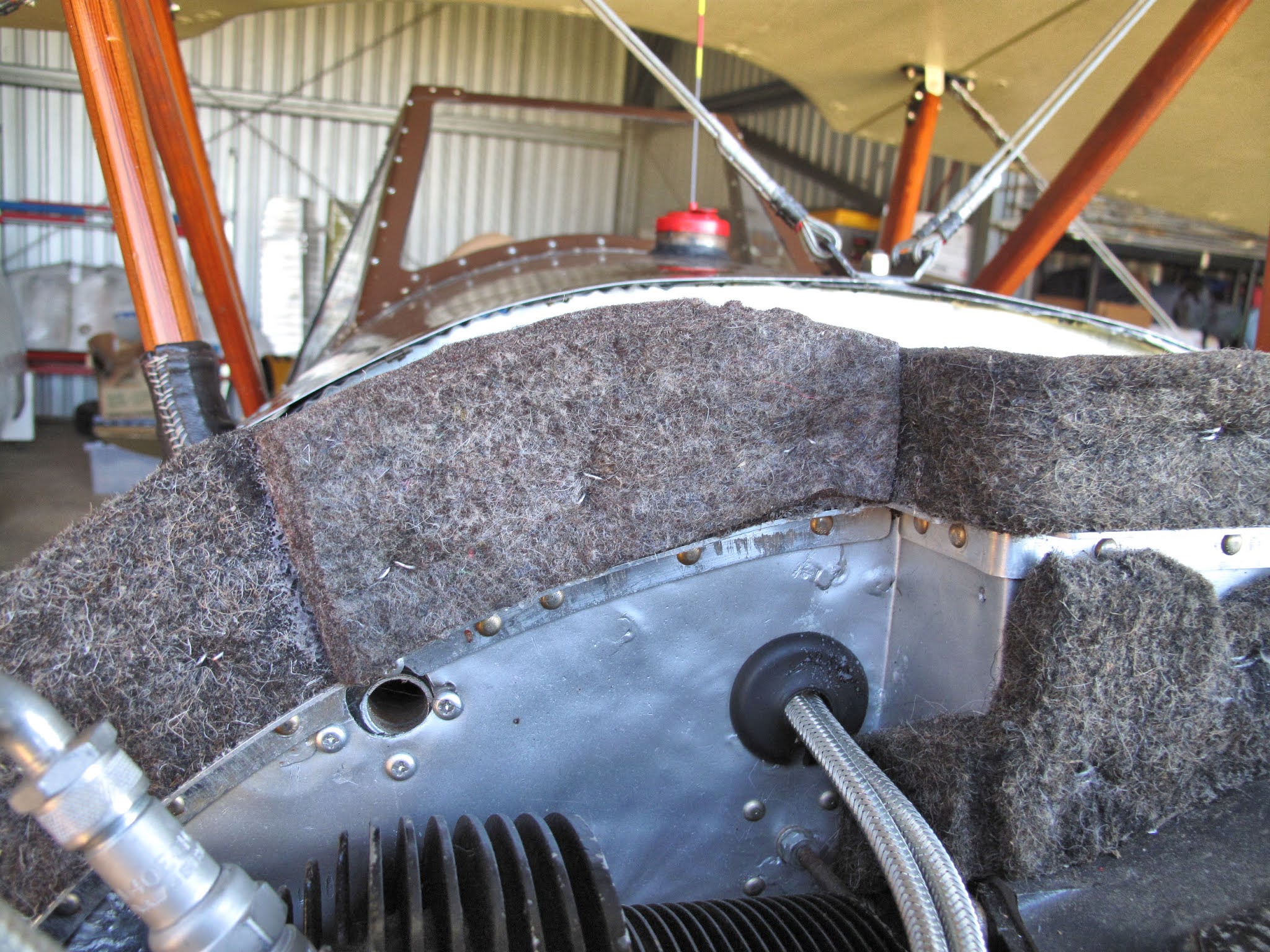
New Felt Seals for the Motor's Main Air Cooling Baffle

 I think I've improved the seals on the main air baffle.

The center section of the seal seams to fit just fine.  The pressure of the cowl pushing down on it forces the felt to tip forward toward.  This should help the air pressure to hold it tight against the cowl.

Therefore I cut that section out from the long seal and reinstalled it.
There is clearly a leak on both sides along the cowl doors.  I stuck "T" pins in the edge of the felt so I could determine where and how big the gap really is.

The doors were fastened shut to push the pins into the felt.

With the light behind the seal I could see that the pins were not pressed too far down.


This gave me a pretty good idea where and how much the seals needed to be widened to get a good seal like in the center.


I cut new pieces and this time I used some spray adhesive to bond the felt to the aluminum, in addition to the staples.  I masked everything to keep the spray only on the baffle.

The new sections are quite  bit taller than the old ones so I trimmed them with the scissors to make a smooth blend.

I also used the scissors to put about a 30 degree chamfer on the aft edge to make it more flexible.  I left the top edge about 1/8" wide and ran the chamfer down the back about 3/4" - 1".  The idea was that this tapered section would tip forward and seal better against the cowl doors.


I made more new staples from 0.041" stainless safety wire, as before, to secure the felt to the baffle.

When I got it all done I found I had a slight gap at the piano hinge for the doors.  I split some felt to about 3/16" thick to make patches for each side.  I glued these to the main pieces and redid the staples, again.


These patches fold over nicely under the hinges and should seal very well.
I also widened the pieces under the rocker covers, on each side.  I had previously moved them outboard, but I don't think they were sealing good enough.  Now they really press against the cowl.


I like how these came out, but I need to fly the plane to see if the cooling problem is solved.  

We have a week of warm sunny weather coming so hopefully that will happen soon.


Tuesday, October 13, 2020

Cooling Air Leak and Ignition Shut-Off Problem

 One of my tasks after the test flight was to re-inspect the plane and particularly the motor to make sure nothing is loose, leaking, etc. as well as making sure once again that everything is properly safetied.  I haven't found any problems, which is good.

Before taking the cowl off I had a bright idea, I should have had ages ago, to put a light behind the main cooling air baffle so I could see if there were any air leaks.  It turns out the cowl doors do not seat against the felt seal on the baffle.

That sliver of a gap is about 3/8" wide in the middle and 12" long.  I have ideas for fixing it.  We'll get back to it in another post.

With the cowl off and the top spark plugs out for safety, I checked the mag. switch wiring with an Ohm meter, but couldn't find a problem.
I decided to remove the mag. switch to see if it was malfunctioning.  Fortunately it's serviceable.  By removing the 2 screws you can remove the back plate.
The fixed contacts look real good and still have grease to prevent corrosion.

The movable contacts bridge from the center, ground, to the outer, magneto, contacts.  They're in good condition also.

The movable contacts are held in place by the springs, which are the same length with no broken coils.


There are detent bumps on the moveable plate, attached to the key tumbler, which hold the switch in each position.

The detent spring is OK and works well.

Overall the switch is not the problem.  I've reassembled and reinstalled it.
Before hooking up the switch I used the magneto timing light to make sure there isn't an open in the magneto's internal wiring by rechecking the point timing.  No problem there.

While reconnecting the switch wiring to the magnetos I found the problem.  The wire on the left magneto had broken at the screw terminal.  I had put a piece of heat shrink tubing over the wire and the end of the terminal as a strain relief.  The idea was to stop motor vibration from wiggling and breaking the wire at the end of the terminal. That was a good plan but, with all the removing and reinstalling of the magnetos I wiggled and broke the wire.  Trapped under the heat shrink tubing it wasn't obvious it was broke.  while holding the meter probe to it for good contact the broken wire made contact, hiding the problem.  I've installed a new terminal, without the tubing.

We'll find out for sure I've solved the problem once I've finished with the baffle leak.  Until then I'll treat it as a hot engine, top plugs out when working around it.


Friday, October 9, 2020

Successful Test Flight


We finally have a day with the wind out of the south at about 7 knots on a warm comfortable day.  I wanted to use runway 23 (to the southwest) for the best emergency landing fields, and the runway is uphill in that direction if an abort was needed, much better than going down hill.

One more thorough preflight inspection just incase I've missed something.  

The plan was to do the normal run up checks then on take-off check that the plane is not wildly out of rig, if yes abort take off.  If that's fine climb in the pattern to 3,000 feet and stay over the airport getting familiar with the plane in normal and slow flight.  The slow flight was intended to understand the airplane and see what the airspeed indicator reads for landing.  There was no plan to do stalls at this point though.

The motor is running and it's time to get started.


Everything checked ok during run-up so were ready to fly.

I was a little jerky on the rudder pedals just before take off and I considered aborting but by then I was off the ground.  The plane flew nice with a light grip on the stick.  The rigging was good so on with the flight.


By the time I was at pattern altitude the cylinder head temperature was at 450 degrees F.  I throttled back to 2,300 RPM and the temp. dropped back down a few degrees and stabilized.  I decided to stay in the pattern at 1,000 feet AGL.  In this picture I'm in the up-wind.  

Any change in speed or power caused the temp. to go up so I decided to come on around and land without any slow flight practice.
In this picture I'm in the down-wind to land back on 23.  I'm sure the Airspeed Indicator has an issue because at one point I was up to 100 MPH, in the downwind.  This Fly Baby has never gone that fast before.  We'll check it out more on the next flight.
On short final the plane started settling very fast and I was slow getting the throttle up enough, One Good Bounce For Mankind.  I got the throttle in on the bounce and with almost all the runway left decided to land.  This time I made a much better landing.  Yay!!!


I discovered another small problem when I got back to the hangar.  The ignition switch wouldn't shut the mags off.  It worked fine every time I taxied the plane.  I shut off the gas and waited a minute or 2 for it to shut down.  We seem to have a weak ground from the switch so I'll probably replace the switch.  

I have some ideas where I may have cooling air leaks so we'll see how that works out.

A good productive day all around!


Monday, October 5, 2020

Brake Dragging Slightly


The left wheel is back off because there was a light drag in one spot.  It was there when I put on the new bladder.  I decided to taxi it a bit and then see if it was still there, of course it was.  It hung up the wheel enough I was worried it would do something squirrely when the wheel started turning on landing.  The right thing to do was to pull it back apart and fix it.
It happened in one spot as the wheel turned so I assume the 70+ year old brake drum is slightly out-of-round as well as something out-of-round with the mechanism.  
First I blued the metal frame thinking it was rubbing, based on the sound.  That wasn't it.

I used the blue marker to blue the entire inside of the drum.  Spinning the wheel rubbed plenty of blue onto 2 of the pads.  I measured those 2 pads and found they were 0.300" thick, basically new.  I sorted through the pads I have and found 2 which were worn  about 0.010" thinner.  That solved the stopping on the pads, but now I could for sure hear metal on metal wear.
I removed the pads and blued the metal frame that holds the pads in position, wheel back on and spin.

With the pads removed there were areas where the blue was rubbed off the frame.  After 4 hours filing a little, cleaning up metal filings, re-bluing, installing the wheel, spinning, removing the wheel and repeat, I stopped the metal rubbing.

The wheel spins great and the brakes are ready for a test flight.

I need the wind to switch back to a southerly wind and we're ready to fly.  Yay!