On my
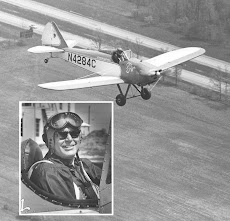
WACO NINE all the external bracing cables use wire wrapped ends. I've learned about the
correct flux to use and made a
solder pot for soldering the wire wrap to the cable. My 1949 copy of CAM 18, section 18.20-4 (d), calls this a Wrap-Soldered Splice. To do this splice correctly the Solder needs to be 50/50 lead/tin with a melting point between 320 and 390 degrees. The flux must be made from 25%-50% stearic acid (tallow) and 75%-50% resin (rosin). Never use Mineral Acid flux, it will cause corrosion and possible hydrogen embrittlement. All the fluxes I've found in the stores are Mineral Acid flux. The wrap or serving wire is a commercial soft-annealed steel or iron wire, thoroughly and smoothly tinned or galvanized. Figure 4-2 shows the size wire to use, etc. My 1940 copy of "Aircraft Maintenance" by Brimm and Boggess has a similar explanation but doesn't completely conform to CAM 18. I keep looking for old training books to work on these old planes. For Fly Baby I'm only using this process to cover the free end of the cable sticking out of the Nicopress sleeve, not for structural strength. At the same time my objective is to learn how to do this so I can make all the cables for the WACO NINE. It has about the same number of cables as the Fly Baby.

I've recently learned there is an easy cheap source of rosin. Dancers use it to dust their shoes. They sell it in quantities up to 50 pound buckets. I've ordered a pound of it and will make a new batch of flux when it arrives. I'll also sell flux.
CAM 18 suggests keeping the flux melted for easy application. I have a little pot and hot plate for doing that. What I found was that as soon as you apply it to the cold wire it solidifies and then melts off before the wire gets hot in the solder pot. The soldering process works better if you apply the flux to hot wire so it cleans the surface better.
To do that I made up sticks with a blob of flux on the end rather than brush it on from a hot pot. You heat the wire in the solder pot, rub on a bit of flux, back in the pot, and repeat as needed. You make the blobs like making candles. Dip the end in the flux pot, twirl it to keep it from dripping until it cools, then repeat until you have a nice blob. I made up about 6 sticks. This gives me one less thing to burn my hands on. I already spent too much on Band-aids.
I noticed as my solder pot heats up the areas where it first melts are where there is some old flux on the surface. I had read that flux helps the bond as well as the melt but didn't believe it, maybe it does help.
I also found you can clean the surface of the pot with a piece of paper towel. It will easily wick up old flux.
You can also wipe a loose end of towel along the surface to move any slag to the end of the pot.
I start the process by marking the bend point 4" from the end.
The end gets dipped in the solder, up to about 1 1/4" - 1 1/2" form the mark, to heat the end. You want the solder to end before the Nicopress sleeve.
It only takes a few seconds to heat the end, then apply the flux with the stick.
Dip it back in the pot to heat it enough for the solder to tin the cable. Re-flux areas which need it and re-dip until the end is tinned to about 1 1/2" from the mark. We don't want solder under the Nicopress sleeve.
I found the soldering of the wire wrap goes better if you tin the end of the cable on the other side of the bend as well. To do that I just bend the cable to control how much of it goes in the pot. You don't need this much bend but I had to use one hand to take the picture.
When you're done both sides are tinned from about 1 1/2" from the bend to about 4". Clean off the flux before forming the bend.
When doing the wire wrap splice Brimm & Boggess suggest bending the tips of the thimble up at 90 degrees, do the wrap and the fold the ends back down over the wrap wire before soldering, as was done by WACO, CAM 18 Figure 4-2 shows the wire wrapped over the ends.
When installing a Nicopress sleeve AC 43.13-1B 7-148c. suggests trimming off the ends so the sleeve will fit better. Just be sure you trim them evenly or it will cause the thimble to tip sideways. A touch on the belt sander, setting square on the table, evens them up nicely.
To get the thimble installed twist it sideways to open it just enough to install it, then twist it back closed. If you pry it open you'll weaken the load bearing end.
The sleeve goes on the cable, then the turnbuckle or fitting.
Make the bend, then slide the sleeve up as far as it will go by hand.
To get a tight fit I have this handy
splicing clamp I made. With the clamp in this position I found that if you wiggle the cable up and down as you tighten the nut you can get the cable very tight around the thimble. With flexible cable it's not a problem but 1x19 non-flexible cable you have to work at it. In hind sight I would make the nut a bigger diameter. I'll see if I can take it back apart and change it.
Once the cable is tight the sleeve moves easily into position for compressing.
For 1/8" cables the sleeve requires 3 compressions. The first is made with the tool centered. Squeeze just enough to ligtly grip the sleeve and make sure the sleeve is tight to the thimble, then finish the squeeze.
The second squeeze is done next to the thimble and the third at the cable end. It takes some practice to get 3 nicely spaced crimps. You also need to make sure the sleeve is not rotated in the crimp jaws or you'll get a tab sticking out of the sleeve, not a good crimp.
Also check your crimps with a gauge to make sure they are fully squeezed. AC 43.13-1B 7-146 requires cables to be proof tested to 60% of the rated strength of the cable. I need to figure out how to do that.
CAM 18 recommends cutting the free end before making the splice, or protect the cable with steel at least .032" thick. I have lots of scrap 20 gauge steel (0.035") form making the
exhaust manifolds for the WACO so I prefer to cut the tinned end to fit after crimping.
When you do the normal wrap you start the end of the wire at the end of the thimble in the gap between the cables. I found an easy way to start the wrap for this was to form a hooked bend at the end of the wire.
Hold it gently in position with pliers while making the first wrap. I also found it helpful to use a piece of Gorilla tape to hold the end of the cable tight while getting the wrap going.
A normal wire wrap for a 1/8" cable takes about 5 feet of 22 gauge serving wire. I'm using about 3 feet here but I'm using 20 gauge wire until I find some 22 gauge. The thicker wire takes a few less turns and I don't wrap where the sleeve is. I've done the wrapping so the finished length is the same as the standard wrapped splice.
I keep the cool end of the pot at 330 - 350 degrees. The soldering process is the same as tinning the long side of the bend. Curve the cable to keep the turnbuckle out of the solder, heat, flux, dip to solder, repeat until well soldered.
If everything isn't perfect you can touch up with a soldering iron. You could do the whole thing with the iron if you have a large enough iron with a big copper. The cable really sucks the heat. I have a 1500 watt iron with a 1/2" copper about 5" long and it struggles to quickly get the cable hot enough to get good solder flow as you work from the small end to the thimble. I used this iron to do stained glass work and you could really push solder at it.
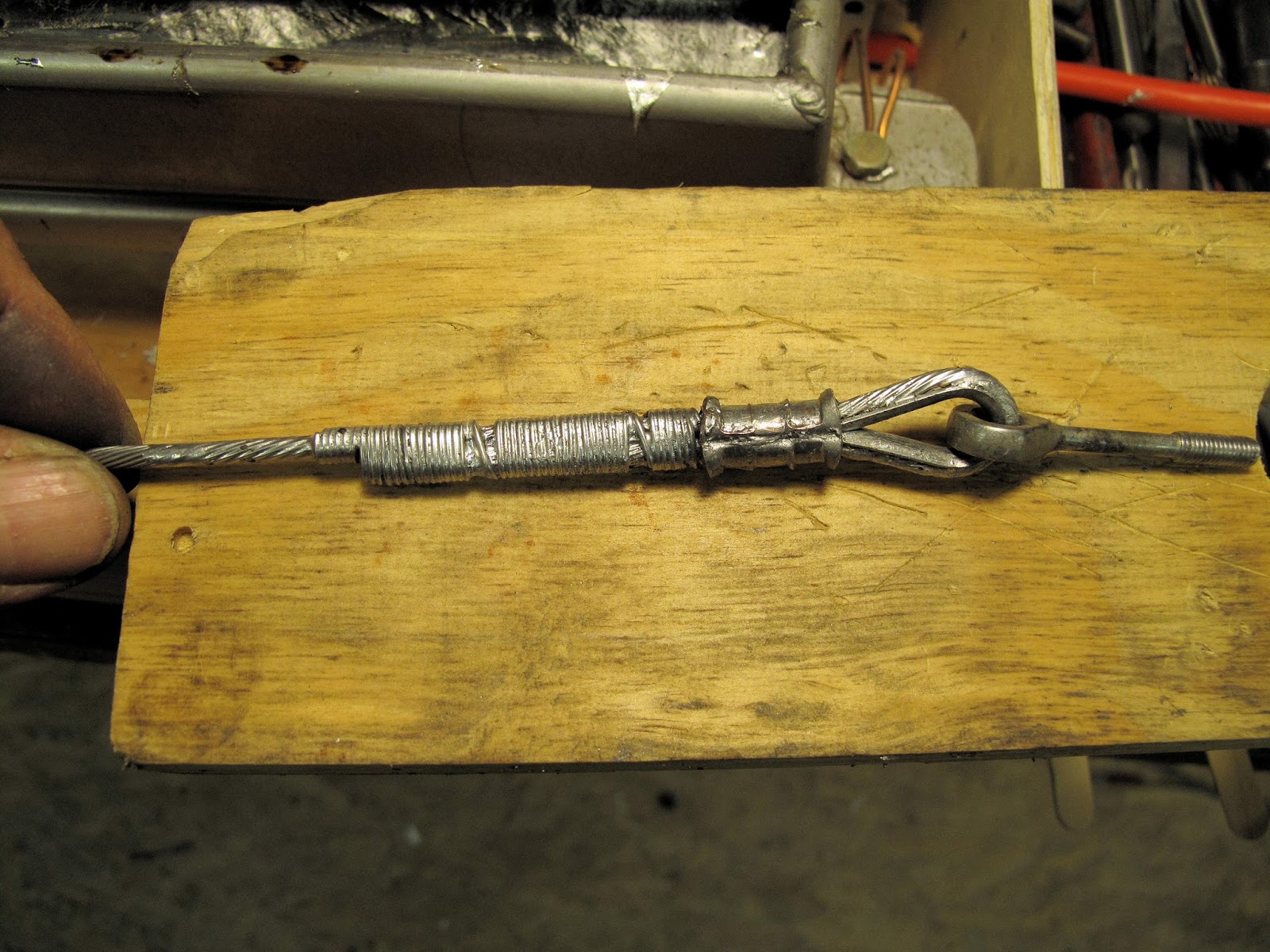
They have the look I wanted and the full strength of the cable.
I've finished the cabane wires and the first wire for the tail surfaces. I like it. Lots more to do.


 I also did my first cable end using the full wire wrap method. Because I didn't have anything on the end I dipped it in the solder pot. It looks just like the cables on the WACO minus the rusty cable. This is so cool!